A look at the technology stack behind Montague Pianos
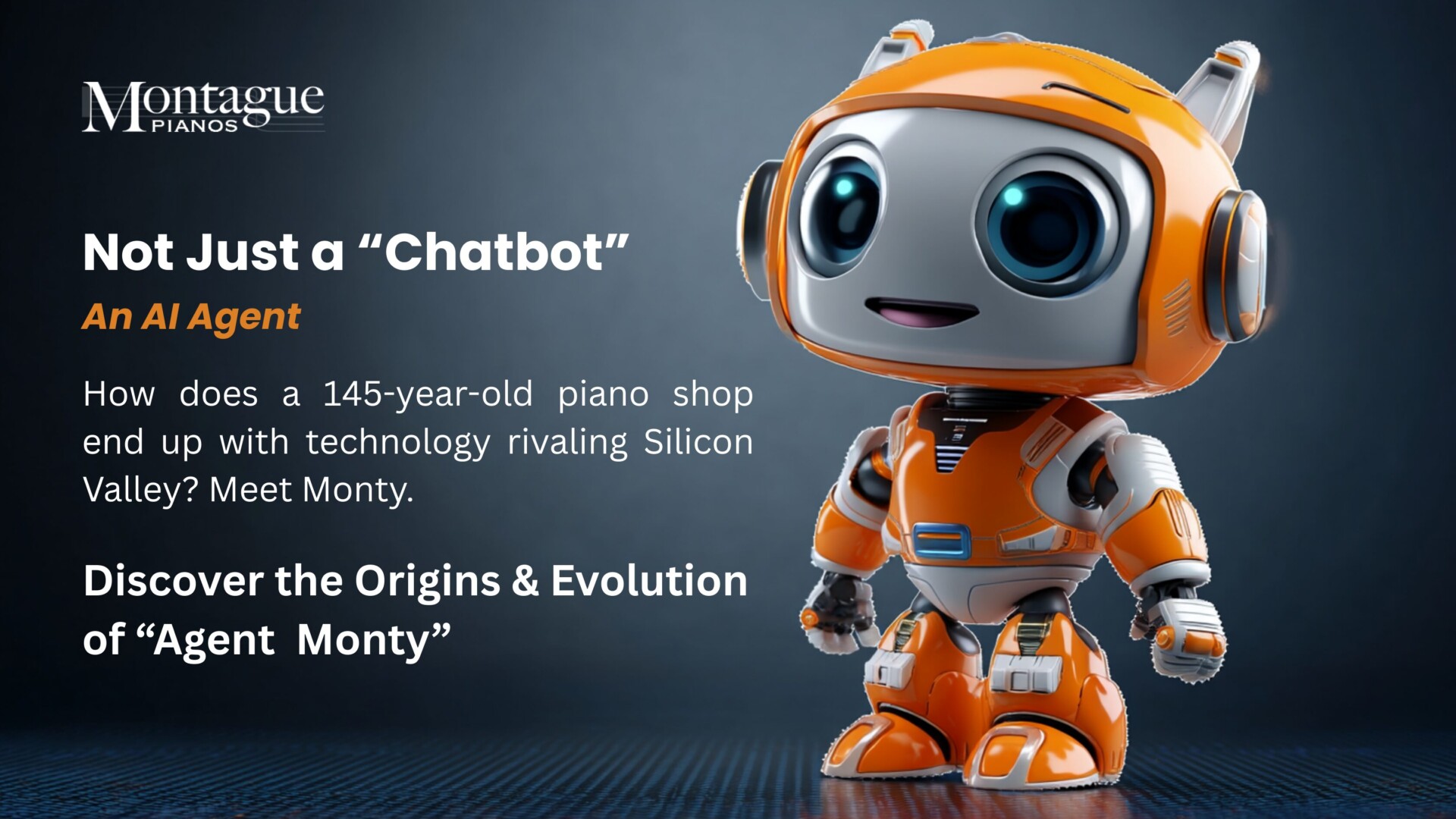
People often ask how on earth Montague Pianos ended up with so much technology. How does a 145-year-old piano shop have its own AI assistant who can talk, reason, find stock, book tunings, take payments, and plan a full day’s route for a human tuner?
The answer is simple: Monty is not a chatbot.
A chatbot is just a familiar name we use because it’s what people recognise. But it’s a massive disservice to what Monty actually is.
Monty is an AI agent.
And that distinction matters.
From 2023 to today: Monty’s evolution
Back in 2023, when we first experimented with ChatGPT-3.5, Monty was charming but not especially clever. In fact, he couldn’t even remember my name from one message to the next.
I’d say:
“Hello, my name is Lee.”
He’d reply:
“Hello Lee, how are you today?”
Then:
“What’s my name?”
“I’m afraid I don’t know your name.”
That was the state of the technology at the time.
Over the next two years, as the models improved, we kept refining Monty with better instructions, clearer boundaries, and more autonomy. Eventually, we reached the point where we weren’t just telling him what to say—we were giving him the tools to do things.
And that’s the moment Monty stopped being a chatbot.
Chatbot vs AI Agent: the real difference
A normal chatbot cannot:
-
see what pianos we have in stock
-
show you actual images of them
-
know their prices, sizes, or specifications
-
access our Google Calendar
-
check availability for tuning appointments
-
plan travel routes
-
enforce travel-time or distance rules
-
take payment
-
update databases
-
talk in real time
-
or coordinate multiple back-end systems at once
Monty can do all of that.
Not because he’s magically smarter, but because we’ve built an entire technical ecosystem around him.
Monty isn’t guessing.
Monty is working.
How Monty books a piano tuning
Let’s take the piano-tuning process as an example, because this shows the difference clearly.
When someone says:
“Can I have a tuning?”
Monty has a lot to do before he can give a sensible time.
-
He connects to the MCP server
This is a custom tool we built that allows him safe, controlled access to our Google Calendar.
-
He retrieves every booked and unbooked slot for the next two months
He has to understand the entire tuning diary before he can offer even a single appointment.
-
He checks the customer’s location
He uses the Google Maps Distance Matrix API to compare the customer’s address with every other appointment.
-
He calculates travel times and distances
We’ve set rules to protect the tuner:
-
never more than 30 minutes between jobs
-
never more than 10 miles between consecutive appointments
-
and all new appointments must remain within 20 miles of our shop in HP4 3QH unless manually overridden
-
-
He filters out unsuitable slots
If the routing doesn’t work, or if a slot would create an impossible day, he simply won’t offer it.
-
He presents the first fifteen viable options
Every time slot Monty offers has been checked, validated, mapped, and approved through logic—not guesswork.
-
And once the customer chooses…
Monty connects to the MCP server again and books the appointment directly into Google Calendar.
-
If payment is required, he initiates Stripe Checkout
Displayed right inside the chat window.
At no point is Monty “making up” a response.
He is calling tools, checking real data, enforcing rules, and using genuine logic.
That is what an AI agent does.
What makes our tech stack special
Monty sits on top of:
-
OpenAI’s Realtime API (voice, reasoning, memory within a session)
-
A custom Python/Flask back-end (the MCP server)
-
Google Calendar API
-
Google Maps Distance Matrix API
-
Stripe Checkout
-
Google Cloud Run
-
Firestore databases
-
Our own inventory system
-
Our own booking logic
-
Our own safety, tone, and instruction layers
It’s not one tool.
It’s an ecosystem—purpose-built for how a piano business actually works.
And Monty is the conductor.
Why we built it
Because Montague Pianos has always believed that tradition and innovation can coexist.
We still tune pianos by hand, restore cabinets with the same care used in 1879, and help families choose instruments that last generations. But behind the scenes, our systems are becoming as modern as anything you’d find in the world’s largest tech companies.
This is how a small family business stays competitive in a fast-moving world:
by building tools that genuinely help customers and make craftsmanship more efficient—not by replacing it.
We hope you enjoyed reading about Montys journey from conception as much as I’ve enjoyed (sometimes) making him. I don’t have access to developers, experience with frameworks or fully understand how to code in any language (by myself).
Over time I hope that Monty will become even more useful and faster (Parallel tool calling is next on the list – I’m sure that’s going to excite a few people haha… or perhaps only me)
Perhaps i’ll give him an email client to use and access to twillio to make calls or send text message reminders. The limit is our imagination!